There’s some sort of cue that every coach will say often.
“Feel the water on your hand.”
“High elbow.”
“Rotate your hips.”
“Squeeze the finish.”
Every one of those points the swimmer’s attention to their own body. And that one small thing might begin to make a big difference.
There’s a whole line of research in motor learning on what’s called the focus of attention. It’s one of the most replicated findings in the field. It splits attention into two kinds. An internal focus points the athlete at their body (the hand, the elbow, the hip) An external focus points them at what the body is doing to the world around it (the water, the wall, the line on the bottom).
Change a word or two in the cue and you change the result.
The pattern barely wavers across sports. An external focus usually beats an internal one. Again, pointing athletes at the effect of their movement produces better performance and better learning than pointing them at the movement itself.
Freudenheim, Wulf, and colleagues (2010) took intermediate swimmers and had them swim a length of freestyle. One group focused on pulling their hands back. Attention on the body. The other focused on pushing the water back. Attention on the effect.
The swimmers thinking about pushing the water were significantly faster.
Second experiment, they added a control group. External focus still won. Faster than the internal group and faster than the swimmers who got no instruction at all.
The word change cost nothing. You don’t have to add anything, buy anything or do anything different. A different choice of words and it’s as simple as that.
Why Would One Word Do That?
The explanation is the constrained action hypothesis.
Point a swimmer at their own body and they start consciously steering movements that are supposed to run on their own. They micromanage the hand or over-control the elbow. That conscious steering interrupts the fast automatic processes that were already handling it just fine.
An external focus gets out of the way. Attention on the water lets the motor system self-organize. It finds its own coordination between all the moving pieces without the swimmer sitting in the driver’s seat yanking the wheel.
The muscle activity data says the same thing. External focus tends to produce cleaner firing and less wasted effort. Less EMG for the same output, sometimes better output. The body does more with less the second the mind stops hovering over it.
Internal focus makes them manage the movement. External focus lets them make the movement.
This Isn’t About Never Talking About the Body
You still have to build those technical elements of the stroke. What changes is how you point them at it.
Almost any internal cue has an external twin. You’re chasing the same technical outcome but you’re just naming it by its effect instead of by the body part doing it.
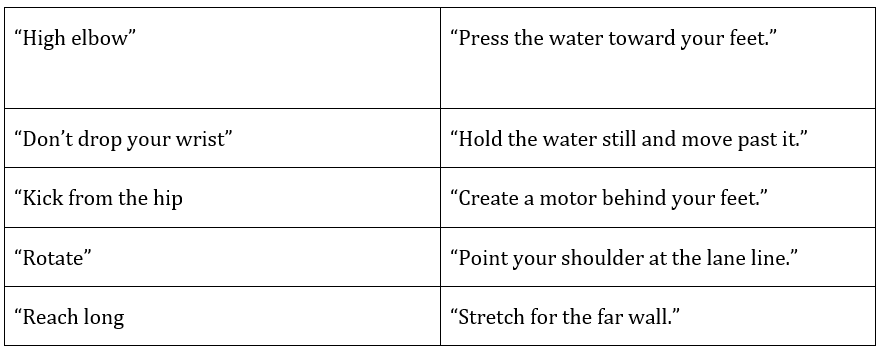
On the left are old cues and on the right are new cues!
This is also why video can bite you with young swimmers, something I’ve written about before. Show a novice footage of their own stroke and you’ve dragged their attention straight onto their body. Internal focus by default. You’ve handed them the exact thing the research says fights against automatic movement.
Try This
Listen to yourself on deck this week.
How many of your cues point at the body? How many point at external elements?
The tendency is to use those internal cues. We were all taught to coach the body. But to do that well, we have to use the more efficient cue.
Take your five most-used cues and rewrite each one to point at the effect. Then go use them.